


In today’s hyper-competitive digital marketplace, businesses are losing potential customers not because of poor products, but because of slow response times and inefficient lead handling. This is where the ai virtual agent is changing the entire sales landscape.
An ai virtual agent is no longer just a chatbot answering basic questions. It has evolved into a powerful digital sales engine capable of engaging visitors, qualifying leads, and guiding them toward purchase decisions in real time. In 2026, businesses are rapidly adopting this technology to reduce human dependency and increase conversion speed.
Alongside this evolution, terms like ai sales agent and AI sales assistant are becoming central to modern sales ecosystems. These intelligent systems work together to ensure that no lead is missed, every inquiry is answered instantly, and every opportunity is optimized for conversion.
This blog explores how AI-driven systems are transforming leads into paying customers and why the ai virtual agent is becoming a silent but powerful sales closer for businesses worldwide.
What is an AI Virtual Agent in Modern Sales?
An ai virtual agent is an intelligent, automated system designed to interact with website visitors or potential customers in real time. Unlike traditional chatbots, it uses natural language processing, machine learning, and behavioral data to understand customer intent and respond in a human-like manner.
In modern sales environments, an ai virtual agent functions like a digital salesperson that never sleeps. It can:
- Engage visitors instantly when they land on a website
- Ask qualifying questions to understand customer needs
- Collect and organize lead data into CRM systems
- Provide product or service recommendations
- Guide users through the buying journey
The biggest difference between a chatbot and an ai virtual agent is intelligence and decision-making ability. While chatbots follow pre-written scripts, AI virtual agents analyze user behavior and adapt conversations dynamically.
Traditional Sales vs AI Virtual Agent Performance
| Metric | Traditional Sales Team | AI Virtual Agent |
| Response Time | 5–30 minutes | Instant (1–2 seconds) |
| Lead Coverage | Limited hours | 24/7 availability |
| Cost per Lead | High | Low |
| Conversion Rate | Moderate | High |
This transformation shows why businesses are rapidly shifting toward AI-driven sales systems.
How AI Virtual Agents Are Becoming AI Sales Agents
The evolution of the ai virtual agent into an ai sales agent represents a major shift in how businesses handle digital selling.
An ai sales agent is designed not only to communicate but also to actively influence buying decisions. It understands customer intent and acts like a trained sales representative.
Modern AI systems are now capable of:
- Handling objections such as pricing concerns or product doubts
- Recommending upsells and cross-sells based on user interest
- Guiding customers toward checkout or booking actions
- Engaging in personalized conversations using customer data
This is where the ai virtual agent becomes powerful—it bridges marketing and sales into a single automated system.
Conversion Growth with AI Sales Agent
- Month 1: 12% conversion rate
- Month 3: 20% conversion rate
- Month 6: 35% conversion rate
- Month 12: 45% conversion rate
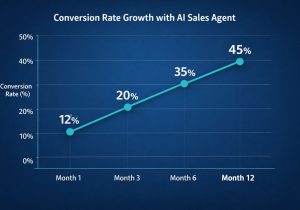
The consistent upward trend demonstrates how AI-driven systems improve over time by learning from user interactions.
By acting as a smart ai sales agent, the system ensures every visitor is nurtured instead of being lost due to delayed human response.
Role of AI Sales Assistant in Converting Leads Faster
The AI sales assistant plays a supportive yet critical role in the overall AI sales ecosystem. While the ai virtual agent handles conversations, the AI sales assistant focuses on execution-based tasks that move leads closer to conversion.
Key responsibilities include:
- Scheduling meetings or product demos automatically
- Sending follow-up emails or messages at the right time
- Reminding leads about abandoned carts or unfinished inquiries
- Updating CRM records with accurate customer data
This combination ensures that no lead is left unattended after initial engagement.
Sales Funnel Time Reduction
| Stage | Without AI | With AI Sales Assistant |
| Lead Response | 10–20 mins | Instant |
| Follow-up Time | 1–2 days | Automated (minutes) |
| Conversion Cycle | 7–14 days | 2–5 days |
The AI sales assistant reduces friction in the sales funnel, making the entire process faster and more efficient.
Read More: AI Virtual Receptionist with Top Lead Qualification Features: The Future of Smart Customer Handling
How AI Virtual Agents Improve Lead Qualification
One of the most powerful capabilities of an ai virtual agent is intelligent lead qualification. Instead of treating every visitor the same way, it analyzes behavior, intent, and engagement patterns to determine lead quality.
For example, it can:
- Identify high-intent buyers based on repeated page visits
- Filter out casual browsers who are not ready to buy
- Assign lead scores automatically
- Prioritize sales-ready prospects for follow-up
This ensures sales teams only focus on warm and hot leads, improving productivity and efficiency.
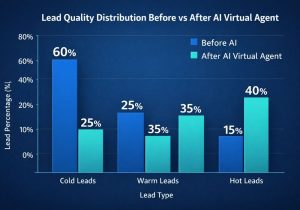
Lead Quality Distribution
| Lead Type | Before AI | After AI Virtual Agent |
| Cold Leads | 60% | 25% |
| Warm Leads | 25% | 35% |
| Hot Leads | 15% | 40% |
The ai virtual agent significantly improves lead quality by filtering irrelevant traffic and identifying real buyers.
Key Benefits for Businesses Using AI Virtual Agents
Businesses adopting the ai virtual agent experience a wide range of operational and financial benefits.
1. 24/7 Customer Engagement
Unlike human teams, AI systems never stop working, ensuring continuous engagement.
2. Reduced Operational Costs
Companies can reduce dependency on large sales teams while maintaining performance.
3. Faster Response Time
Immediate engagement increases the chances of converting visitors into customers.
4. Higher ROI on Marketing Campaigns
Every lead captured is handled efficiently, reducing wastage of ad spend.
5. Scalable Sales System
Businesses can handle thousands of leads simultaneously without increasing staff.
Real Business Impact: Conversion Growth Model
The impact of an ai virtual agent becomes clear when comparing performance before and after implementation.
A typical business might see:
- Before AI: 10–15% conversion rate
- After AI virtual agent: 30–45% conversion rate
This improvement comes from instant response, better personalization, and consistent follow-ups.
Conversion Rate Growth
- Month 1: 15%
- Month 3: 28%
- Month 6: 38%
- Month 12: 45%
This upward trend shows how AI continuously improves sales performance over time.
Future of AI Virtual Agents in Sales
The future of the ai virtual agent is becoming more advanced and human-like every year. In 2026 and beyond, we can expect:
- Voice-enabled AI sales conversations
- Emotion recognition during customer interactions
- Predictive selling based on customer behavior
- Fully automated end-to-end sales funnels
The combination of ai virtual agent, ai sales agent, and AI sales assistant will create fully autonomous sales ecosystems where human intervention is minimal but strategic.
Businesses that adopt early will have a strong competitive advantage in digital sales transformation.
Conclusion
The evolution of the ai virtual agent is reshaping how businesses convert leads into customers. It is no longer just a support tool—it has become a complete sales automation system capable of engaging, qualifying, and converting leads efficiently.
When combined with an ai sales agent and AI sales assistant, businesses gain a powerful ecosystem that increases revenue, reduces costs, and improves customer experience.
As we move deeper into 2026, companies that adopt AI-driven sales systems will outperform those relying solely on traditional methods.
At the forefront of this transformation, Webart Technology helps businesses implement intelligent AI virtual agent solutions that turn every lead into a potential conversion opportunity.
Frequently Asked Questions (FAQs)
1. What is an AI virtual agent in sales?
An ai virtual agent is an intelligent automated system that interacts with website visitors, understands their needs, and helps convert them into customers by guiding them through the sales process in real time.
2. How does an AI virtual agent help increase conversions?
An ai virtual agent increases conversions by responding instantly to leads, qualifying them automatically, and providing personalized recommendations that guide users toward making a purchase decision.
3. What is the difference between an AI sales agent and an AI sales assistant?
An ai sales agent actively engages with customers, handles objections, and drives sales conversations, while an AI sales assistant supports backend tasks like follow-ups, scheduling, and CRM updates.
4. Can AI virtual agents replace human sales teams?
No, they do not completely replace humans. Instead, the ai virtual agent works alongside sales teams by handling repetitive tasks, allowing humans to focus on high-value closing and strategy.
5. Are AI virtual agents suitable for small businesses?
Yes, small businesses benefit greatly from an ai virtual agent because it reduces staffing costs, improves lead response time, and helps scale sales operations without additional manpower.


